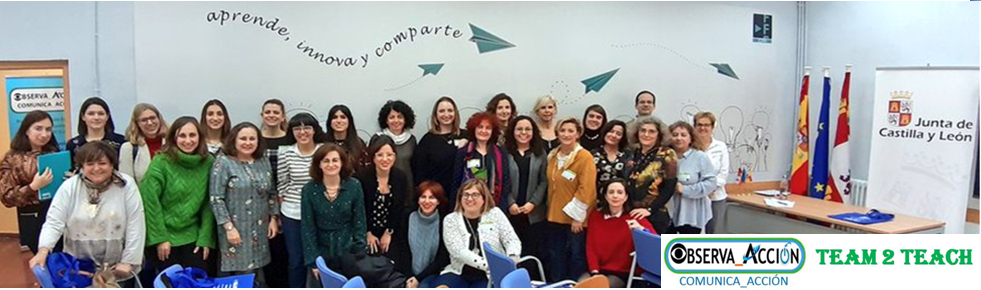

Louise Ellen Wright shares her #Team2Teach experience in the CEIP Morales del Vino
"On
the 3rd of March 2020, it was the turn of Virginia to be observed by
the three of us. (Veronica, Laura and myself) and it was to be the
second of our four observation days. We were received by Virginia in
the main hall and introduced to her colleagues and directive team who
all made us feel very welcome.
The first hour of the timetable on that Tuesday morning was a free class for her, so Virginia gave us a tour of the primary school. Whilst walking through the corridors she explained about the various initiatives and projects that they had going on in the school that year, or ones that had been started as a permanent fixture, which included healthy eating, recycling and reducing the use of plastic in the school. (Students and parents alike are instructed not to bring any snack contained in plastic other than a reusable Tupperware). This was all of great interest to us and I have already passed on the idea to the head teacher in my school as it will fit in well with the projects we have planned for the coming school year. What was also of interest on the doors of all the classrooms, was a system for promoting positive behaviour and maintaining tidy classrooms. Each class is assigned a name consisting of a vegetable or fruit character. ('Nanzarine' was one example where we could see a character based on an orange/ tangerine with arms legs and face drawn by the children. Other examples were personalities made from carrots, broccoli and tomatoes- also with invented names. )
We were also impressed by the displays and artwork around the corridors, which demonstrated to us that the teaching staff worked very well together to produce joint efforts and cross curricular projects, and made for effective and eye-catching murals, all of which I found very inspiring.
The second hour of the morning we were able to observe Virginia in one of the art and craft classes that she imparts. Her timetable is entirely made up of teaching Art and Craft and P.E.. All of which she gives in English, in addition to the English classes that the children are given by her colleagues.
So, from 10am to 11am we saw how the Quinto art class was delivered to the students. It was very interesting to see how the children responded and participated in the class discussion about Logos, -which was the topic for that week. There were only 12 students in the class, so the ambiance was very tranquil and the students certainly seemed to benefit from this , as well as feeling comfortable enough to answer the questions in English.. Virginia spoke all the time to the class in English and started off by refreshing their memories on the topic of the month which was nature and colour theory. She demonstrated on the board about the use of different simplified shapes that well known companies use for their logos, in order to have more impact than more complicated shapes. When the students were set onto the task of creating their own logo in their sketchbooks, Veronica, Laura and I were able to walk around the class and chat quietly to the individual children to see how they interpreted the instructions. They all seemed keen to use as much English as they could while talking to me and proudly showed me through the pages of their sketchbook from previous exercises and projects. Some were displayed on the walls too, and the students talked enthusiastically about their work. Virginia doesn't use a dictated or ready prepared book of art projects that so many other schools use here, which I was pleased to see.. (I have always felt they were rather dry and uninspiring, and was surprised to see them in use when I first arrived in Spain.) Instead, she prefers to create her own projects. As a result the sketchbooks were full of interesting work that the students had clearly enjoyed doing. It is also clear that they enjoy learning English through art and benefit from it being a subject that doesn't always require reading or studying grammar!!
One of the main things we observed about Virginia's teaching style is how she talks calmly to the class and even when there were moments that one or two children were not on task or behaving as they should, she stayed calm and focussed, and didn't let those students distract the others , nor get annoyed. This was of particular interest to observe as as bad behavioural issues are often moments that, as a teacher, we can often lose our patience and raise our voices. Virginia however, stayed patient and calm and this helped the class also stay calm and focussed.
The next class of Virginia's that we observed was after break time, when she had the Segundos for Art and Craft. She arrived to the class with some boxes of ready prepared squares of coloured paper for the children to use on a collage task. For these younger students she used a lot of T.P.R to start the class and gave instructions with a chant-like repetition to refresh their vocabulary on colours, class material and shapes. It was a useful tool which, for the children seemed like a game but meant that they could respond by holding up the correct article from their pencil cases up in the air, after she had said to them all.....¨show me. show me, show me....... your blue pen´ for example. It meant they could participate without it putting pressure on them as individuals. For reinforcing the vocabulary of shapes, which they later needed for making images of animals, volunteers were called up to the front of the class to have a shape 'drawn' on their backs.. .. The child had to guess what had been marked on their back. Again, this seemed like a game to them and was a useful idea to use in future classed for my infants too. It set a relaxing and fun atmosphere ready for them to start the task of sticking small pieces of paper to collage onto their chosen drawn animal made from shapes such as triangles rectangles, etc.
The third and final class we observed was a P.E class with he Primeros. Prior to taking the class out to the playground, Virginia allowed the children to demonstrate their understanding of ordenal numbers and prepositions, (again with a T.P.R activity) while they were lined up indoors. Once out, we were able to join in with the activities which she had planned for the children. These consisted of many more chants, songs and dance movements to do whilst reinforcing vocabulary for the days of the week, months of the year, numbers and other actions. All the while, the students joined in by singing and chanting with her, either in a large circle or following her on the lines painted on the playground.
They clearly enjoyed the activity and as it was dynamic and easy enough for them to follow. Once again, it meant they could be learning with the pressure of being asked to talk or answer questions in front of their classmates.
This was a great opportunity to observe the use of English classes in Arts and Crafts and P:E. in a school that doesn't have the same number of hours as a MEC/ British council project school. Whilst the Sciences can, for young children be overwhelming in English, dynamic subjects like Art and Physical education are very different, and a lot of vocabulary, listening skills and comprehension can be gained and promote a relaxed atmosphere for the acquisition of a foreign language.
It was a valuable day and we came away with lots of new ideas and inspiration to use in our own classes, even though we don't all have the same type of timetable as Virginia has in Morales Del Vino.
For my part, (as my timetable is spent entirely in infants), it was useful to observe other age groups. I very much enjoyed visiting a different school. It's always useful to be stimulated by new experiences!!"
The first hour of the timetable on that Tuesday morning was a free class for her, so Virginia gave us a tour of the primary school. Whilst walking through the corridors she explained about the various initiatives and projects that they had going on in the school that year, or ones that had been started as a permanent fixture, which included healthy eating, recycling and reducing the use of plastic in the school. (Students and parents alike are instructed not to bring any snack contained in plastic other than a reusable Tupperware). This was all of great interest to us and I have already passed on the idea to the head teacher in my school as it will fit in well with the projects we have planned for the coming school year. What was also of interest on the doors of all the classrooms, was a system for promoting positive behaviour and maintaining tidy classrooms. Each class is assigned a name consisting of a vegetable or fruit character. ('Nanzarine' was one example where we could see a character based on an orange/ tangerine with arms legs and face drawn by the children. Other examples were personalities made from carrots, broccoli and tomatoes- also with invented names. )
We were also impressed by the displays and artwork around the corridors, which demonstrated to us that the teaching staff worked very well together to produce joint efforts and cross curricular projects, and made for effective and eye-catching murals, all of which I found very inspiring.
The second hour of the morning we were able to observe Virginia in one of the art and craft classes that she imparts. Her timetable is entirely made up of teaching Art and Craft and P.E.. All of which she gives in English, in addition to the English classes that the children are given by her colleagues.
So, from 10am to 11am we saw how the Quinto art class was delivered to the students. It was very interesting to see how the children responded and participated in the class discussion about Logos, -which was the topic for that week. There were only 12 students in the class, so the ambiance was very tranquil and the students certainly seemed to benefit from this , as well as feeling comfortable enough to answer the questions in English.. Virginia spoke all the time to the class in English and started off by refreshing their memories on the topic of the month which was nature and colour theory. She demonstrated on the board about the use of different simplified shapes that well known companies use for their logos, in order to have more impact than more complicated shapes. When the students were set onto the task of creating their own logo in their sketchbooks, Veronica, Laura and I were able to walk around the class and chat quietly to the individual children to see how they interpreted the instructions. They all seemed keen to use as much English as they could while talking to me and proudly showed me through the pages of their sketchbook from previous exercises and projects. Some were displayed on the walls too, and the students talked enthusiastically about their work. Virginia doesn't use a dictated or ready prepared book of art projects that so many other schools use here, which I was pleased to see.. (I have always felt they were rather dry and uninspiring, and was surprised to see them in use when I first arrived in Spain.) Instead, she prefers to create her own projects. As a result the sketchbooks were full of interesting work that the students had clearly enjoyed doing. It is also clear that they enjoy learning English through art and benefit from it being a subject that doesn't always require reading or studying grammar!!
One of the main things we observed about Virginia's teaching style is how she talks calmly to the class and even when there were moments that one or two children were not on task or behaving as they should, she stayed calm and focussed, and didn't let those students distract the others , nor get annoyed. This was of particular interest to observe as as bad behavioural issues are often moments that, as a teacher, we can often lose our patience and raise our voices. Virginia however, stayed patient and calm and this helped the class also stay calm and focussed.
The next class of Virginia's that we observed was after break time, when she had the Segundos for Art and Craft. She arrived to the class with some boxes of ready prepared squares of coloured paper for the children to use on a collage task. For these younger students she used a lot of T.P.R to start the class and gave instructions with a chant-like repetition to refresh their vocabulary on colours, class material and shapes. It was a useful tool which, for the children seemed like a game but meant that they could respond by holding up the correct article from their pencil cases up in the air, after she had said to them all.....¨show me. show me, show me....... your blue pen´ for example. It meant they could participate without it putting pressure on them as individuals. For reinforcing the vocabulary of shapes, which they later needed for making images of animals, volunteers were called up to the front of the class to have a shape 'drawn' on their backs.. .. The child had to guess what had been marked on their back. Again, this seemed like a game to them and was a useful idea to use in future classed for my infants too. It set a relaxing and fun atmosphere ready for them to start the task of sticking small pieces of paper to collage onto their chosen drawn animal made from shapes such as triangles rectangles, etc.
The third and final class we observed was a P.E class with he Primeros. Prior to taking the class out to the playground, Virginia allowed the children to demonstrate their understanding of ordenal numbers and prepositions, (again with a T.P.R activity) while they were lined up indoors. Once out, we were able to join in with the activities which she had planned for the children. These consisted of many more chants, songs and dance movements to do whilst reinforcing vocabulary for the days of the week, months of the year, numbers and other actions. All the while, the students joined in by singing and chanting with her, either in a large circle or following her on the lines painted on the playground.
They clearly enjoyed the activity and as it was dynamic and easy enough for them to follow. Once again, it meant they could be learning with the pressure of being asked to talk or answer questions in front of their classmates.
This was a great opportunity to observe the use of English classes in Arts and Crafts and P:E. in a school that doesn't have the same number of hours as a MEC/ British council project school. Whilst the Sciences can, for young children be overwhelming in English, dynamic subjects like Art and Physical education are very different, and a lot of vocabulary, listening skills and comprehension can be gained and promote a relaxed atmosphere for the acquisition of a foreign language.
It was a valuable day and we came away with lots of new ideas and inspiration to use in our own classes, even though we don't all have the same type of timetable as Virginia has in Morales Del Vino.
For my part, (as my timetable is spent entirely in infants), it was useful to observe other age groups. I very much enjoyed visiting a different school. It's always useful to be stimulated by new experiences!!"


