Mostrando entradas con la etiqueta ZAMORA. Mostrar todas las entradas

sábado, 30 de mayo de 2020

Videoconferencia impresiones finales


Ayer por la tarde nos reunimos para hacer una valoración de la actividad que desafortunadamente se quedó incompleta, a falta de una observación. A pesar de ello, las cuatro integrantes de este equipo de Observa-acción coincidimos en que ha sido una experiencia muy enriquecedora y 100% recomendable. Todas nosotras repetirems la experiencia el próximo curso, seguro.
Aquí os adjunto el resultado de las cuestiones que abordamos ayer esperando que sea de ayuda para vosotros.

1.     ¿Qué actividades de las observadas en las primeras visitas pudisteis aplicar con vuestros alumnos? ¿Cómo fue el resultado? ¿Qué actividades les gustaron más a vuestros alumnos?
Dictados de Jesús Chaparro por Youtube, Técnicas de gestión de la autoestima y estaciones de aprendizaje.
A pesar de las circunstancias sí que se pudo aplicar lo observado a nuestras aulas. Las arriba mencionadas son algunas de las herramientas y actividades que se han llevado a cabo con éxito en todos los casos.

2.     ¿Qué metodologías destacarías de las utilizadas por tu compañero?

Las metodologías y herramientas de aprendizaje que hemos visto son: Aprendizaje Basado en Proyectos, aprendizaje cooperativo, rutinas de pensamiento, Inclusión de segundo idioma en la elaboración de recetas, enseñanza tutorado, uso de las TIC…

3.     ¿Qué actividades de las observadas en las primeras visitas habéis podido aplicar en la enseñanza online con vuestros alumnos?
El dictado por video de youtube, cuentos colectivos.

4.     ¿Qué herramientas pedagógicas y de comunicación con alumnos estáis aplicando en la enseñanza online? Analiza y comparte las que consideras más útiles para tus compañeros.
Herramientas interactivas: Genial.ly, padlet, canva, Kahoot, Wordwall, educaplay,
Sistema de comunicación: BLOG, teams, videollamada whatsapp, correo electrónico, llamadas de teléfono, Classdojo.

5.     ¿De qué manera se gestiona la comunicación con tus compañeros y tu centro ante el cierre de centros escolares?
Teams, videollamadas con zoom, jitsi.org, correo electrónico y Whastapp.


6.     ¿Cómo habéis gestionado y solucionado la posible falta de acceso a medios digitales de alguno de vuestros alumnos?
Llevándole fichas fotocopiadas a su casa (con la colaboración del ayuntamiento), tarjeta de datos de JCYL,  llamadas de teléfono, whatsapp.

7.     ¿Qué impacto ha tenido participar en el proyecto OBSERVA_ACCIÓN en vuestra práctica docente?
Muy positivo. Ha sido una experiencia muy enriquecedora. Te hace darte cuenta de cómo se trabaja en contextos distintos. Por otro lado te abre la posibilidad de vivir otras experiencias fuera de tu centro. Te abre la mente. Te permite estar abierta a nuevas experiencia en otros centros dentro o fuera de tu provincia. Todo lo que ves en el centro lo empiezas a adaptar mentalmente a tu realidad de tu centro. Se te despierta la capacidad de adaptación. Y ampliar tu mente hacia otras experiencias distintas.

8.     ¿Qué valoración haces del proyecto OBSERVA_ACCIÓN en su conjunto?
Sobresaliente. Altamente recomendable y que se mantenga bajo demanda. Presión la primera vez pero luego te relajas cuando ves el ambiente de compañerismo, se respeta el trabajo de los compañeros.
9.     ¿Cómo definirías OBSERVA_ACCIÓN en una palabra o una frase?
Compartir / enriquecedor / altamente recomendable 
María García

lunes, 11 de mayo de 2020

Visita al CEIP La Villarina Zamora


Impresiones sobre la visita al CEIP. La Villarina.
Luz y Rosa.

Pincha en la imagen para leer el documento.


martes, 5 de mayo de 2020


Louise Ellen Wright shares her #Team2Teach experience in the CEIP Morales del Vino


"On the 3rd of March 2020, it was the turn of Virginia to be observed by the three of us.  (Veronica, Laura and myself) and it was to be the second of our four observation days.  We were received by Virginia in the main hall and introduced to her colleagues and directive team who all made us feel very welcome.  

The first hour of the timetable on that Tuesday morning was a free class for her, so Virginia gave us a tour of the primary school.  Whilst walking through the corridors she explained about the various initiatives and projects that they had going on in the school that year, or ones that had been started as a permanent fixture, which included healthy eating, recycling and reducing the use of plastic in the school.  (Students and parents alike are instructed not to bring any snack contained in plastic other than a reusable Tupperware). This was all of great interest to us and I have already passed on the idea to the head teacher in my school as it will fit in well with the projects we have planned for the coming school year.  What was also of interest on the doors of all the classrooms, was a system for promoting positive behaviour and maintaining tidy classrooms.  Each class is assigned a name consisting of a vegetable or fruit character.   ('Nanzarine' was one example where we could see a character based on an orange/ tangerine with arms legs and face drawn by the children. Other examples were personalities made from carrots, broccoli and tomatoes- also with invented names. )

We were also impressed by the displays and artwork around the corridors, which demonstrated to us that the teaching staff worked very well together to produce joint efforts and cross curricular projects, and made for effective and eye-catching murals, all of which I found very inspiring.  

The second hour of the morning we were able to observe Virginia in one of the art and craft classes that she imparts.  Her timetable is entirely made up of teaching Art and Craft and P.E.. All of which she gives in English, in addition to the English classes that the children are given by her colleagues.   

So, from 10am to 11am we saw how the Quinto art class was delivered to the students.  It was very interesting  to see how the children responded and participated in the class discussion about Logos, -which was the topic for that week.  There were only 12 students in the class, so the ambiance was very tranquil and the students certainly seemed to benefit from this , as well as feeling comfortable enough to answer the questions in English.. Virginia spoke all the time to the class in English and started off by refreshing their memories on the topic of the month which was nature and colour theory.  She demonstrated on the board about the use of different simplified shapes that well known companies use for their logos, in order to have more impact than more complicated shapes.  When the students were set onto the task of creating their own logo in their sketchbooks, Veronica, Laura and I were able to walk around the class and chat quietly to the individual children to see how they interpreted the instructions.  They all seemed keen to use as much English as they could while talking to me and proudly showed me through the pages of their sketchbook from previous exercises and projects.  Some were displayed on the walls too, and the students talked enthusiastically about their work.  Virginia doesn't use a dictated or ready prepared book of art projects that so many other schools use here, which I was pleased to see.. (I have always felt they were rather dry and uninspiring, and was surprised to see them in use when I first arrived in Spain.)  Instead, she prefers to create her own projects.  As a result the sketchbooks were full of interesting work that the students had clearly enjoyed doing.  It is also clear that they enjoy learning English through art and benefit from it being a subject that doesn't always require reading or studying grammar!!

One of the main things we observed about Virginia's teaching style is how she talks calmly to the class and even when there were moments that one or two children were not on task or behaving as they should, she stayed calm and focussed, and didn't let those students distract the others , nor get annoyed.  This was of particular interest to observe as as bad behavioural issues are often  moments that, as a teacher, we can often lose our patience and raise our voices.  Virginia however, stayed patient and calm and this helped the class also stay calm and focussed.  

The next class of Virginia's that we observed was after break time, when she had the Segundos for Art and Craft.  She arrived to the class with some boxes of ready prepared squares of coloured paper for the children to use on a collage task.  For these younger students she used a lot of T.P.R to start the class and gave instructions with a chant-like repetition to refresh their vocabulary on colours, class material and shapes.  It was a useful tool which, for the children seemed like a game but meant that they could respond by holding up the correct article from their pencil cases up in the air, after she had said to them all.....¨show me. show me, show me....... your blue pen´ for example.  It meant they could participate without it putting pressure on them as individuals.  For reinforcing the vocabulary of shapes, which they later needed for making images of animals, volunteers were called up to the front of the class to have a shape 'drawn' on their backs.. .. The child had to guess what had been marked on their back.  Again, this seemed like a game to them and was a useful idea to use in future classed for my infants too. It set a relaxing and fun atmosphere ready for them to start the task of sticking small pieces of paper to collage onto their chosen drawn animal made from shapes such as triangles rectangles, etc.  
The third and final class we observed was a P.E class with he Primeros.  Prior to taking the class out to the playground, Virginia allowed the children to demonstrate their understanding of ordenal  numbers and prepositions, (again with a T.P.R activity) while they were lined up indoors.  Once out, we were able to join in with the activities which she had planned for the children.  These consisted of many more chants, songs and dance movements to do whilst reinforcing vocabulary for the days of the week, months of the year, numbers and other actions.  All the while, the students  joined in by singing and chanting with her,  either in a large circle or following her on the lines painted on the playground. 

They clearly enjoyed the activity and as it was dynamic and easy enough for them to follow.  Once again, it meant they could be learning with the pressure of being asked to talk or answer questions in front of their classmates.  
This was a great opportunity to observe the use of English classes in Arts and Crafts and P:E. in a school that doesn't have the same number of hours as a MEC/ British council project school.  Whilst the Sciences can, for young children be overwhelming in English, dynamic subjects like Art and Physical education are very different, and a lot of vocabulary, listening skills and comprehension can be gained and promote a relaxed atmosphere for the acquisition of a foreign language.  

It was a valuable day and we came away with lots of new ideas and inspiration to use in our own classes, even though we don't all have the same type of timetable as Virginia has in Morales Del Vino.  

For my part, (as my timetable is spent entirely in infants), it was useful to observe other age groups.  I very much enjoyed visiting a different school.  It's always useful to be stimulated by new experiences!!"

lunes, 4 de mayo de 2020

Sesión final del CEIP NRA SRA LA PAZ, CEIP MORALES DEL VINO, CEO CORESES, CEIP RIOMANZANAS


VIDEOCONFERENCIA TEAM TO TEACH

A continuación podéis leer el guión con las conclusiones de la última video-conferencia que hemos realizado en  nuestro TEAM TO TEACH de Zamora. 
Gracias, un año más, por dejarnos disfrutar de este proyecto que nos llena de ilusión y de aire fresco que llevar a nuestras aulas.


GUIÓN VIDEO-CONFERENCIA EQUIPOS


1. ¿Qué actividades de las observadas en las primeras visitas pudisteis aplicar con vuestros alumnos? ¿Cómo fue el resultado? ¿Qué actividades les gustaron más a vuestros alumnos?

Como no todas las profesoras que formamos el equipo TEAM to TEACH de Zamora trabajamos en los mismos niveles y sólo nos ha dado tiempo a realizar dos de las cuatro visitas programadas, no hay tantas actividades que se presten a su posible aplicación en el aula. Algunas de estas actividades son el uso de rutinas para que nuestros alumnos se sientan seguros a la hora de hablar en inglés, rutinas como el calendario, una canción de buenos días o de bienvenida a todos los compañeros, el repaso de los colores y los números…etc. También el uso de los cuentos en inglés como recurso de realia y de contacto directo con la cultura anglosajona.

2. ¿Qué metodologías destacarías de las utilizadas por tu compañero?

De las dos visitas realizadas en el CEIP RIOMANZANAS y el CEIP MORALES DEL VINO destacamos su metodología activa, el cambio de una actividad a otra para que los niños mantengan la atención, consiguiendo clases muy dinámicas y fáciles de seguir. Recalcamos el esfuerzo de nuestras compañeras por adecuar el nivel de la clase para que sea accesible a todos, consiguiendo que los niños se sientan seguros y se atrevan a hablar en inglés.  Además, hemos podido comprobar lo importante que es el uso prácticamente exclusivo del inglés (90% del tiempo), consiguiendo que niños de infantil de 3, 4 y 5 años sean capaces de comprender y seguir la clase entera y según van creciendo y dejando atrás el bien conocido SILENT PERIOD, se sientan en un entorno seguro para expresarse en inglés.

3. ¿Qué actividades de las observadas en las primeras visitas habéis podido aplicar en la enseñanza online con vuestros alumnos?

Reflexionando sobre esta pregunta hemos llegado a la conclusión de que todas estamos usando medios audiovisuales en versión original como songs: https://supersimple.com/super-simple-songs/,
Busy beavers,


https://www.dreamenglish.com/,
https://es.lyricstraining.com/,
https://www.youtube.com/.…etc


y story telling:

https://www.twinkl.es/resources/literacy/story-resources/traditional-tales, https://www.youtube.com/,
https://www.oxfordowl.co.uk/for-home/find-a-book/library-page ,
http://infantil1920.blogspot.com/p/english.html (cuentos narrados por nuestra compañera Louise)


4. ¿Qué herramientas pedagógicas y de comunicación con alumnos estáis aplicando en la enseñanza online? Analiza y comparte las que consideras más útiles para tus compañeros.

Como sabéis en esta situación cada profesor está dando (o al menos intentando dar) lo mejor de sí mismo para seguir en contacto con sus alumnos y las herramientas son muy diversas. Enumero las que hemos citado en nuestra video-conferencia: comunicación (Teams, los blogs de nuestros colegios y otros blogs educativos), evaluación y gamificación (Kahoot challenge, Socrative, Forms y Quizizz), grabación de vídeos (OBS studio), fichas y juegos interactivos:

https://www.eslgamesplus.com/,
https://www.liveworksheets.com/,
https://learningapps.org/,
https://quizlet.com/es
https://www.educandy.com/,
https://www.mes-games.com/

presentación de contenido:
https://es.padlet.com/
https://www.genial.ly/


5. ¿De qué manera se gestiona la comunicación con tus compañeros y tu centro ante el cierre de centros escolares?

Reuniones semanales a través de Whatsapp o de la plataforma Teams. El equipo directivo da las pautas generales y después los compañeros se comunican a través del Whatsapp (en su mayoría).

6. ¿Cómo habéis gestionado y solucionado la posible falta de acceso a medios digitales de alguno de vuestros alumnos?

Hicimos un listado, citando los problemas de conexión que teníamos con algunos alumnos y con el recuento de datos general la Junta de Castilla y León proporciona a los alumnos que lo necesiten tarjetas SIM de datos de 60 Gb. Esa partida de tarjetas, de la compañía Movistar, la facilitó el Ministerio de Educación y Formación Profesional. También se están entregando otras 1.000 que Vodafone ha puesto a disposición de la Consejería de Educación.

7. ¿Qué impacto ha tenido participar en el proyecto OBSERVA_ACCIÓN en vuestra práctica docente?

El impacto en todas nosotras ha sido muy positivo. Hemos hecho un gran equipo y todas coincidimos en que ha sido una inyección de motivación y de ganas de seguir aprendiendo y mejorando en nuestra práctica docente. Al mismo tiempo nos sentimos muy cómodas ayudándonos unas a otras, compartiendo nuevos recursos e intercambiando materiales o simplemente charlando sobre nuestro día a día en el aula o ahora en casa.

8. ¿Qué valoración haces del proyecto OBSERVA_ACCIÓN en su conjunto?


Todas consideramos que el proyecto OBSERVA_ACCIÓN sigue siendo un año más la mejor formación que podemos recibir. Nos adentramos en la clase de un compañero para formar parte de su dinámica y ser por unas horas, un alumno más. Además, recibimos de nuestros “observadores” otro punto de vista diferente a nuestras clases, ellos realizan una crítica constructiva que nos indica cómo seguir mejorando. Y esto no se limita al espacio del aula porque en realidad, estás viendo todos los engranajes de un colegio, conociendo su claustro, sus alumnos, sus instalaciones, los proyectos que realizan…etc. Eres testigo de actividades que funcionan y qué puedes trasladar a tu colegio y a tu aula. Todo, absolutamente todo, es aprendizaje.

9. ¿Cómo definirías OBSERVA_ACCIÓN en una palabra o una frase?

Para definir lo que significa el proyecto OBSERVA_ACCIÓN para nosotras hemos realizado la siguiente WORD CLOUD.


lunes, 27 de abril de 2020

VISITA CEIP RIOMANZANAS , LOUISE E. WRIGH


El pasado 6 de febrero realizamos nuestra primera visita.Le tocó el turno a Louise que nos recibió  muy amablemente en el precioso hall del edificio de Educación Infantil del centro. Louise es nativa y trabaja en un centro bilingüe del British Council impartiendo inglés en educación infantil , 6 horas con cada grupo, y música ,1 hora semanal compartida con el maestro especialista de música.
Empezamos la mañana en la clase de 3 años y quedé muy sorprendida de la autonomía que tenían los 25 alumnos para quitarse sus abrigos, gorros, bufandas y guantes y dejarlas en sus respectivas perchas. A continuación entraron en el aula y se sentaron en la alfombra para empezar la clase. Louise empezó haciendo la asamblea en inglés con una tonadilla: One, two, three, cross your legs, fold your arms and quiet please, luego hizo con todo el grupo a finger song: Peter pointer. Después eligió al responsable que fue cantando las canciones de la asamblea: Good morning to you song, Elephant song para los días de la semana, Little snail ( caracol,col, col...), repasaron los números, y lo que más captó mi atención fue el calendario de animales de creación propia con el que trabaja las rutinas: los meses, días de la semana...hace canciones con él y trabaja el vocabulario, phonics, chants, pronunciación.... El calendario tiene fotos de animales y cantan canciones con cada animal. Louise les hace preguntas constantemente :``Is it Monday today? (3) No, it isn¨t. Monday is finished. Monday was the colour...red. Is Thursday today? (3) Hooray (2) because tomorrow is....Friday".
Una vez hecha la asamblea les cuenta un libro de los medios de transporte: On the move, continuamente hace rimas y tonadillas: This is my scooter, my scooter is red¨. Alucino con la comprensión de niños tan pequeños, aunque tengan tantas horas a la semana en inglés, son muy receptivos y participan continuamente repitiendo y pronunciando fantásticamente las palabras.El cuento lo escuchan de nuevo en un radiocassette que Louise lleva en un carrito con los cuentos y el material que usa clase por clase.También cuenta otra historia de Maisy y una vez contadas, repite las historias omitiendo palabras para que los alumnos las adivinen ( colores, medios de transporte).
En 4 años (18 alumnos) hace la asamblea igual que en la clase anterior, nos presenta y los niños también se presentan en inglés, litlle by little. Louise hace rimas con cualquier cosa hasta con el cable del cassette. Cuando lo enchufa y el cassette emite el ruido característico de búsqueda de emisora hace como que escuchan el mar, ``the sea, the wavy sea´´. Hace canciones de dedos ( two little dickie birds/ Peter pointer). He de destacar que en el aula hay un niño autista al lado de ella todo el rato que le ayuda con los colores. Louise está muy pendiente de que todos repitan, tienen mucha fluidez. Trabaja con ellos canciones , cuentos sobre Means of transport, colours, un póster con medios de transporte y escenifican las canciones Row your boat y The wheels on the bus.
En 5 años  l(21 alumnos) los niños se presentan sólos. Hace la asamblea igual que en todos los grupos. Esta clase es más movida, también influye que es la hora antes del recreo y vienen de Educación Física.Los niños se saben las canciones y participan. A veces entienden y responden en español porque no saben decirlo en inglés. Louise les corrige en inglés. Trabaja mucho los phonics con tarjetas grandes y cuentos con mucho ritmo como por ejemplo `` Duck in a truck¨.
Después del recreo Joane nos permitió asistir a su clase de inglés en 5º (22 alumnos). Los niños empezaron la clase recomendando libros a otros compañeros de  la clase de 4º. Después hicieron una clase sobre Romeo and Juliet, contando el tema del libro, los personajes de cada familia. Completaron un texto sobre Shakespeare y su obra . Me llamó la atención que los alumnos usan el inglés todo el rato e incluso se corrigen entre ellos. Después escucharon la canción de Dire Straits sobre Romeo and Juliet y completaron una ficha sobre ella.
Me encantó visitar a Louise y aprender tanto de ella. Usó muchos cuentos que no conocía así como el material de Oxford para trabajar los phonics. Fue un verdadero placer ver y oír a los niños hablando en inglés con esa fantástica pronunciación  y atención. También he de agradecer la visita de nuestra asesora Esther, siempre tan implicada en todo. THANK YOU VERY MUCH!!
Laura Vega

martes, 10 de marzo de 2020

Primera visita al CEIP VALLE DEL GUAREÑA


María Martín en su primera visita al CEIP VALLE DEL GUAREÑA


"El pasado martes, 3 de marzo, tuvo lugar nuestra primera observación. Concha (CEIP La Villarina - Zamora) y yo (CRA Alfoz de Toro_Morales de Toro) nos desplazamos hasta Fuentesaúco para conocer mejor su cole y la labor de sus maestras Rosa y Luz. Fue una experiencia muy enriquecedora.
La mañana la comenzamos con una reunión con el director y la jefa de estudios para ponernos en contexto. Nos explicaron características del colegio, alumnos, proyectos que llevan a cabo y al final nos hicieron una visita guiada por el centro.
Tras esta primera toma de contacto nos fuimos a clase de Rosa (2º de EP) y allí pudimos conocer de primera mano su manera de trabajar por proyectos y como aplica rutinas de pensamiento con sus alumnos.


Después de recreo fuimos a la biblioteca a observar como los alumnos de la clase de Luz exponían su proyecto, enmarcado en el plan de fomento a la lectura, sobre Pipi Calzaslargas. Montaron un video y contaron a sus compañeros quién era Pipi y cuales eran sus características. 

Al finalizar la actividad todos los alumnos que participaban en ella realizaron la rutina de pensamiento CSI que pusieron en común con todo el grupo. Además durante toda la jornada pudimos observar muchos de los trabajos que en el colegio se habían realizado para Lugares de Libro y su plan  en torno a mujeres relevantes bajo el título Las olvidadas, las recordadas. Un magnífico trabajo."


"Para finalizar la jornada, fuimos a clase de Luz con sus alumnos de 3º EP para realizar unas dos dinámicas de educación emocional enfocadas a mejorar la autoestima de los alumnos de su aula."


"Fue un verdadero placer poder observar cómo trabajan Rosa y Luz y como se llevan proyectos a cabo en el centro.
Muchas gracias a estas compañeras y al resto del equipo docente del CEIP Valle del Guareña por compartir con nosotras su trabajo. Ha sido muy provechoso y realmente enriquecedor. Hasta la próxima semana!"


domingo, 1 de marzo de 2020

EN EL IES ALFONSO IX_ ZAMORA


Paula María Boyano describes her job shadowing sessions to Cristina en el IES Alfonso IX:


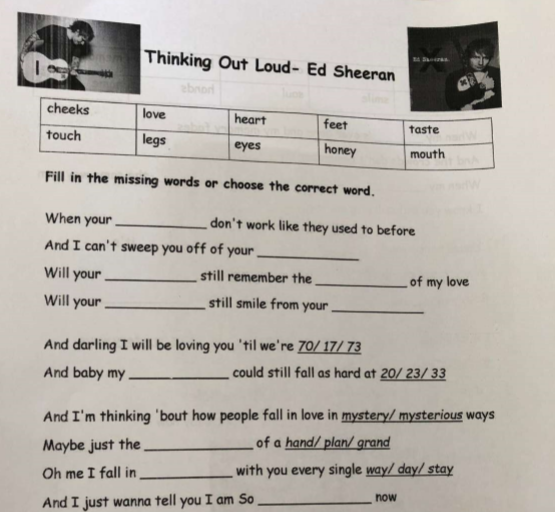
"Our day at Alfonso IX started at 10.45 with 2º of ESO. There were 10 students with quite a low level of English but they were very participative. Cristina played Ed Sheeran's song "thinking out loud" to work with vocabulary related to the parts of the body. Students were requested to fill in the gaps with the words missing and to re-order the chorus. As the level is low, Cristina played the videoclip with both English and Spanish subtitles and she was moving around all the time helping each student individually. They all loved the song! 

In our next lesson, 3º of ESO (25 students), another Sheeran's song was played but this time without any subtitles as their English was adequate to their level. With this song, they worked their listening skills and the correct word-order in statements. 


After this, we had a little fifteen-minute break and we returned with 4º of ESO. There were 18 students with, again, an average level of English. Cristina played a short but very direct video about the different stages of life as she wanted to work with vocabulary related to this topic. At first she played it without stop, but then she played it again several times emphasizing each stage of life and asking students about different objects that appeared in it. As homework, students have to write a composition about this topic using the new vocabulary they have learnt. All the compositions are a 30 % of the final mark in each term.


Our final class was 2º of Bachillerato (9 students). All of them were very participative and they really enjoyed the lesson. Cristina played a video "in a heartbeat" about homosexuality in order to have a discussion about this. As in 4º of ESO, students have to write a composition about this topic which is, not the 30, but the 20 % of the final mark. 


It was a wonderful experience!"

viernes, 7 de febrero de 2020

Visiting Lara Lebrero at IES. Los Sauces (Benavente)

                                            
We were prepared to see 4º ESO (19 students) and 3º ESO (16 students). This school organized the groups by level of competence, both were advanced.
 After introducing themselves talking about their preferences and hobbies in a fluent English, they dealt with different activities throughout the sessions. 
   4º ESO: was presented a video (from a series "Stranger things") without sound. Students had to create a dialogue for the scenes they were watching (about 1 min.) They were just given the name of the characters.
   For the second part of this session,  revision of an extra activity. After having read a book, each student had to formulate 2 questions with 4 possible answers, indicating the correct one to the teacher, and the pages on the book where they picked them up from. This way the teacher later revised the questions and uploaded them in Kahoot. Later the whole class played Kahoot made from their own work. Eventually students worked on reported speech based on those ideas.
   3º ESO: Lara showed a video of a song "Friday I´m in love" by The Cure. Students have the lyrics with some underlined words which they have to put in columns according to their sounds. They discovered some music from the 80´s which they didn´t know they loved.
   Second part of the session they were asked some questions about conditionals: " If you could travel in time, where would you go?"- "If you were stranded on a desert island, what would you take?"
   They were very collaborative, well behaved groups. Good use of ICTs., school decorated with signs in English all around the walls in the corridors. They participate in different projects.
   We visited a classroom called "The future room", very light, airy, open planned area with  trapezoid tables,  devices, cushions,...
   It has been an amazing experience, loads of new ideas to learn from!
CRISTINA DE LOZAR